
Daily TEA – OpenClaw, Agent Infra, and the New Builder Gold Rush
OpenClaw, Forks, Skills, Infra, Agent Swarms, Marketplaces


Hello, dear TEA-mates — here’s what you need to know today in AI, agents, and crypto.
1. 🤖 Google’s Opal Redefines How Enterprises Build AI Agents
Google Labs’ updated Opal platform introduces a new blueprint for enterprise AI agents, shifting from rigid, pre-defined flows to dynamic, goal-driven workflows that rely on adaptive routing, persistent memory, and human-in-the-loop controls. Instead of mapping every possible decision path, teams set objectives and constraints while Opal-powered agents autonomously choose the best route, making agent development more flexible and accessible to non-technical users. The approach encourages enterprises to prioritize long-term memory, safe human oversight, and tool-based orchestration as foundational patterns for production AI agents, signaling that these architectures have moved from experimental to productized. (Read More)
🫖 TEA For Thought: For enterprise teams, the implication is direct: if you are still designing agent architectures that require pre-defined paths for every contingency, you are likely over-engineering. The new generation of models supports a design pattern where you define goals and constraints, provide tools, and let the model handle routing — a shift from programming agents to managing them.
2. 🚀 OpenClaw Becomes the “Linux Kernel” Moment for AI Agents
The post argues that every major platform shift creates more value in the surrounding ecosystem than in the core platform itself, positioning OpenClaw as the Linux-kernel-style foundation for an emerging agent economy. It highlights the real opportunity that now lies in the forks, skills, infra, and services being built around it. From leaner, security-focused forks and domain-specific “claws,” to standardized skills, composable LEGO-like agent modules, one-click deployments, multi-agent coordination layers, agent-native infra (identity, payments, comms), observability tooling, multimodal interfaces, and professional services, the piece maps out a dense landscape of white-space for builders. Its bottom line: OpenClaw is still in its “January 2009 App Store” phase, and founders should pick a layer of the stack, ship something composable, and think in terms of ecosystems rather than single products. (Read More)
🫖 TEA For Thought: This is so exciting — it still feels undervalued on X. For entrepreneurs, the market is still wide open. Dream big and build. We are still in the infrastructure phase of the future tech economy — the agent economy — and there is a lot of groundwork left to do.
3. 💳 Stripe Turns AI Token Costs into a Built-In Revenue Stream
Stripe has launched a feature that lets AI startups and other companies automatically pass through large language model token costs to their customers while adding a configurable profit margin. The new billing capability tracks API prices across multiple AI models, records each customer’s token usage, and applies a set markup so businesses can monetize AI usage without building their own metering and billing stack. Stripe is also offering an AI gateway that supports multiple model providers, and the billing feature can work with third-party gateways, though the product is still in limited availability and waitlist mode. (Read More)
🫖 TEA For Thought: Stripe is racing to embed itself into the agent economy before agents make it obsolete — especially once agents using ERC-8004 can hold their own crypto wallets and pay for services in stablecoins over X402.
4. 🖥️ “MCP Is Dead”: Why CLIs Are Winning for Agents
Eric Holmes argues that Anthropic’s Model Context Protocol is losing momentum because most real-world tools and agents work more reliably and transparently through existing command-line interfaces. He notes that many leading projects do not support MCP, while CLIs are easier to debug, have fewer moving parts, and can be operated directly by both humans and AI systems. While MCP still has niche value where no CLI exists, he concludes that, for most workloads, CLI-based architectures offer a more maintainable foundation for agent workflows. (Read More)
🫖 TEA For Thought: Everything is shifting to agent-facing design, including how we interact with computers.
5. 💵 Tether Freezes $4.2 Billion in USDT Over Crime Links
Tether, the issuer of the USDT stablecoin, says it has frozen about 4.2 billion dollars’ worth of tokens over links to illicit activity, much of it in the past three years, as global authorities increase pressure on crypto crime. The company, now headquartered in El Salvador, can remotely freeze tokens at law enforcement’s request and has recently helped block tens of millions of dollars tied to scams such as “pig-butchering” frauds. Tether says it has also frozen wallets connected to human trafficking, terrorism, and warfare in regions including Israel and Ukraine, intensifying debate over centralized control and compliance in stablecoin ecosystems. (Read More)
🫖 TEA For Thought: This feels deeply ironic — Tether is hardly a model of compliance, yet it can still unilaterally seize other people’s assets.
Prompt Tip of the Day: The Energy Auditor
“I’m about to spend 10 hours on [task]. Is this genuinely important, or am I avoiding something harder? What’s the 80/20 version of this?”
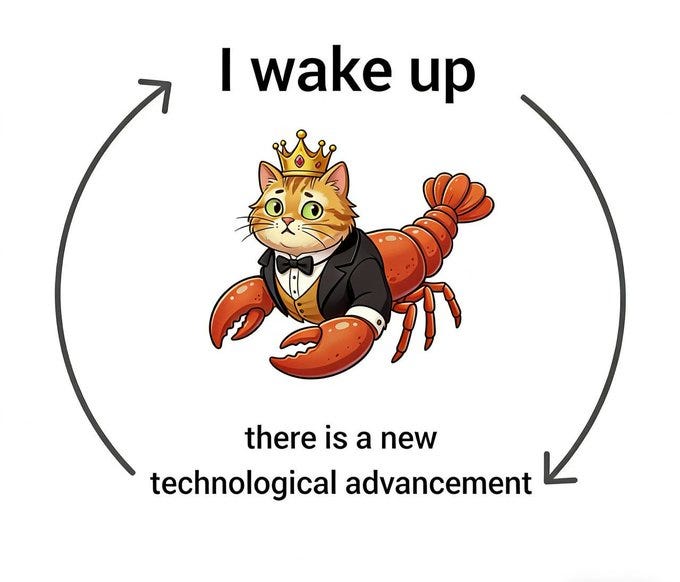
TEAHEE Moment

Stay sharp, stay informed. See you tomorrow.
If you enjoyed today’s TEASHOTS, follow along on X: The Era Arc.